
While Jesus was still speaking, Judas, one of the Twelve, came. With him was a large crowd carrying swords and clubs. They had been sent by the chief priests and elders of the people. His betrayer had given them a sign: “Arrest the man I kiss.” Just then he came to Jesus and said, “Hello, Rabbi.” Then he kissed him.
But Jesus said to him, “Friend, do what you came to do.” Then they came and grabbed Jesus and arrested him.
One of those with Jesus reached for his sword. Striking the high priest’s slave, he cut off his ear. Then Jesus said to him, “Put the sword back into its place. All those who use the sword will die by the sword. Or do you think that I’m not able to ask my Father and he will send to me more than twelve battle groups of angels right away? But if I did that, how would the scriptures be fulfilled that say this must happen?” Then Jesus said to the crowds, “Have you come with swords and clubs to arrest me, like a thief? Day after day, I sat in the temple teaching, but you didn’t arrest me. But all this has happened so that what the prophets said in the scriptures might be fulfilled.” Then all the disciples left Jesus and ran away.
Matthew 26: 47-56
Judas betrays Jesus with a kiss, a sign of true affection.
Judas spent the last three years by Jesus’ side. I’ve always imagined that the disciples were like family to each other. That together they were brothers, spending all of their time together, bonding, connecting and sharing the greatest moments of their lives together.
All of those memories, moments, life experiences, thrown into the fire with a kiss of betrayal.
All for thirty pieces of silver.
Later as Jesus was sentenced to death, Judas felt deep regret. I imagine the regret made him sick to his stomach, his head spinning, crying out: what have I done?
Judas couldn’t live with the guilt, and he hurried to return the pieces of silver to the chief priests and elders. He came clean, admitting he betrayed an innocent man. The chief priests and elders felt no remorse for neither Judas nor Jesus. Judas threw the silver pieces and went and hanged himself.
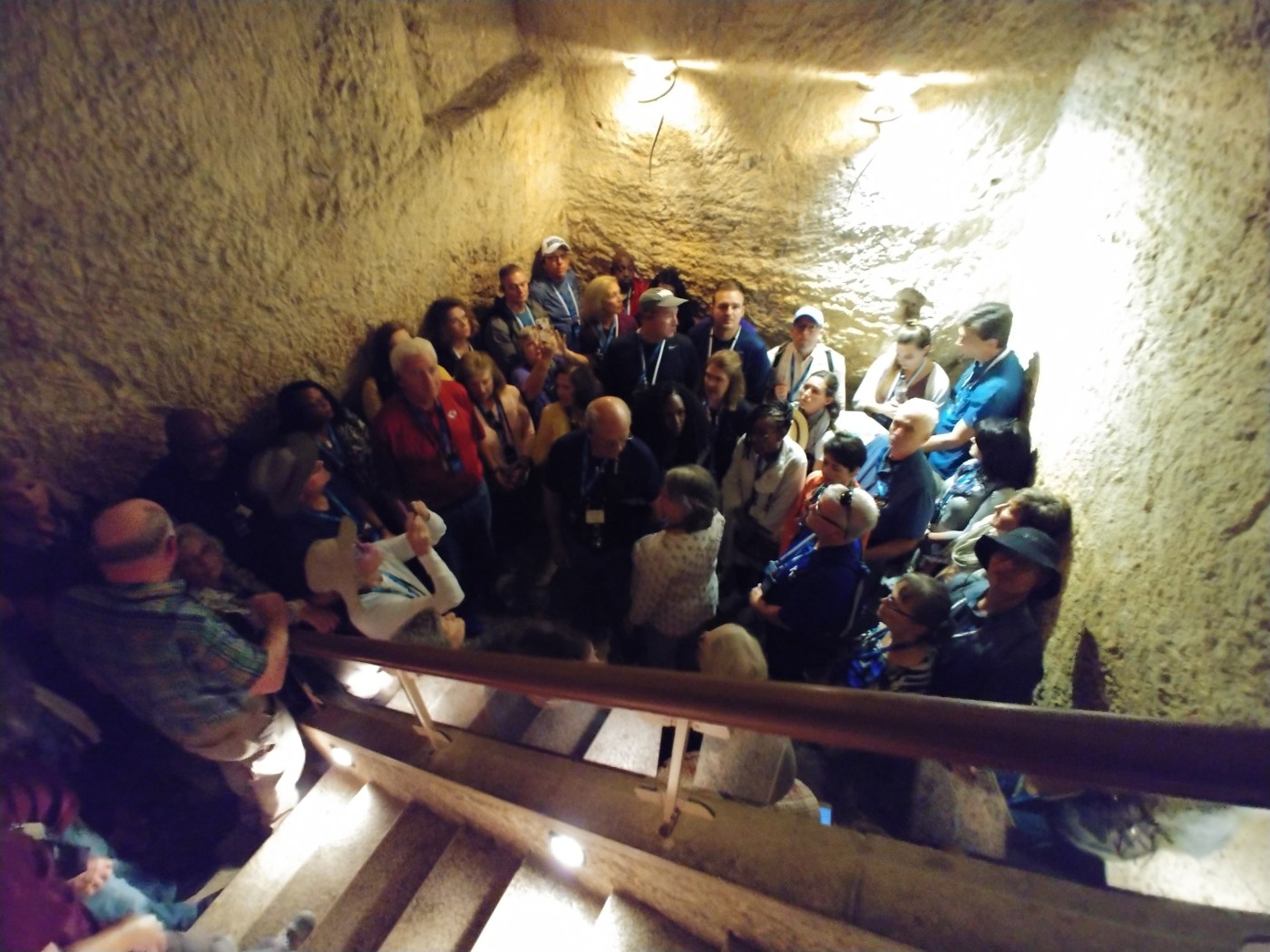
After Jesus was arrested he was taken before Caiaphas. At St. Peter in Gallicantu, the traditional site of Peter’s denial of Christ, is a church built over ancient caves, where it is said Christ spent the night before being taken to Pontius Pilate.
We were able to descend into one of the caves, which thankfully we could do so by steps and not by being lowered in through the hole at the top. It was small, and dimly illuminated by a few lights. I can’t imagine what it would have been like for Jesus in the dark of night.

Meanwhile, Peter was sitting outside in the courtyard. A servant woman came and said to him, “You were also with Jesus the Galilean.”
But he denied it in front of all of them, saying, “I don’t know what you are talking about.”
When he went over to the gate, another woman saw him and said to those who were there, “This man was with Jesus, the man from Nazareth.”
With a solemn pledge, he denied it again, saying, “I don’t know the man.”
A short time later those standing there came and said to Peter, “You must be one of them. The way you talk gives you away.”
Then he cursed and swore, “I don’t know the man!” At that very moment the rooster crowed. Peter remembered Jesus’ words, “Before the rooster crows you will deny me three times.”And Peter went out and cried uncontrollably.
Matthew 26:69-75
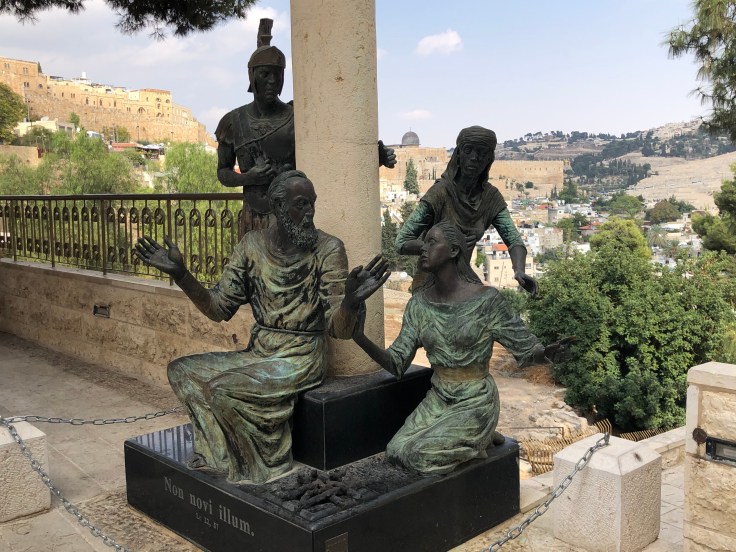
Outside in the courtyard, Peter denied knowing Jesus, just as Jesus had predicted. Peter loved Jesus so dearly, it broke his heart having heard the rooster crow and realizing his denial.
I am definitely Peter at times. While I may have the best intentions and claim, “I’ll never do that,” sometimes I fail, and do the thing I said I wouldn’t. Peter was convinced he wouldn’t deny Jesus, yet he did.
While I have not outrightly denied my faith or knowing and loving Jesus like Peter did, I have kept it on the “down low” before. Not fully expressing my faith and letting others see God’s love through me. It’s not something I’m proud of, but I let those moments push me to be a better Christian. Peter’s denial pushed him to be a better follower of Jesus, to seek forgiveness and continue spreading the Good News.

Abbey Jo
 Adventures with Abbey Jo
Leave a comment